MLpot switching reference
Visual reference for ML/MM handoff switches and staged heating. Start here for the full picture (monomer colors, radius ladder, LR solvers, force quivers): Hybrid potential: cutoffs, regions, and long-range solvers.
For CHARMM atom-pair switching (fshift / fswitch / vfswitch on VDW and cdie Coulomb) used in the CGenFF JAX clone, see CHARMM CGenFF JAX clone. That layer is independent of the COM handoff below.
Dimer force vector panels (DCM / ACO at COM distances across switch zones): dcm_dimer_forces_cutoffs.png, aco_dimer_forces_cutoffs.png in docs/images/mlpot-settings/.
Figures are generated locally by:
uv run python scripts/plot_mlpot_settings.py
Output directory: docs/images/mlpot-settings/.
CLI flags: mmml/interfaces/pycharmmInterface/cutoffs.py (--mm-switch-on, --mm-switch-width, --ml-switch-width). Dynamics: CHARMM_SETTINGS.md.
What The Three Numbers Mean
The switches use monomer COM-COM distance r, not atom-atom distance. The default tuple is:
mm_switch_on / mm_switch_width / ml_switch_width = 8.0 / 5.0 / 1.5 Å
| Region | COM distance r |
ML scale s_ML |
MM scale s_MM |
|---|---|---|---|
| Pure ML | r <= mm_switch_on - ml_switch_width |
1 | 0 |
| Handoff | mm_switch_on - ml_switch_width < r < mm_switch_on |
smoothly 1→0 | smoothly 0→1 |
| MM tail | mm_switch_on <= r < mm_switch_on + mm_switch_width |
0 | smoothly 1→0 |
| Off | r >= mm_switch_on + mm_switch_width |
0 | 0 |
For the default 8 / 5 / 1.5 Å, this means:
r <= 6.5 Å: ML two-body term is fully on; switched MM is off.6.5 < r < 8.0 Å: ML hands off to MM;s_ML + s_MM = 1.8.0 <= r < 13.0 Å: ML is off; MM decays to zero.r >= 13.0 Å: both switched two-body terms are off.
The switching functions are scale factors on the pair interaction energy, so a plotted “potential” will only look smooth if you plot s_ML(r) * E_ML(r) + s_MM(r) * E_MM(r). Plotting the raw scales alone only shows the handoff weights.
Preventing Collapsed COM Contacts
The handoff switches do not stop monomers from entering unphysical short-COM geometries. If the ML dimer surface has a deep collapsed/reactive basin, add a pairwise inter-monomer COM lower wall:
V_COM(r) = 0.5 * k * (r_min - r)^2   if r < r_min
         = 0                         otherwise
Use:
--min-com-restraint-distance 6.0 \
--min-com-restraint-k 1.0
Start with r_min = 5.5–6.5 Å for DCM testing, then tune from scan plots. This restraint is independent of --flat-bottom-radius: the flat-bottom sphere keeps the cluster/droplet contained, while the COM lower wall prevents two monomers from collapsing into each other.
The COM wall is evaluated in the JAX/MMML callback (calculator_utils.apply_com_lower_wall), not as a CHARMM bonded/MMFP term. It applies to pairwise monomer COM distances (MIC-aware under PBC).
Current Equations
Default runs use complementary handoff:
handoff_start = mm_switch_on - ml_switch_width
handoff_end   = mm_switch_on
mm_tail_end   = mm_switch_on + mm_switch_width
s_ML(r) = 1 - sharpstep(r, handoff_start, handoff_end, gamma=GAMMA_ON)
s_MM(r) = (1 - s_ML(r)) *
          (1 - sharpstep(r, handoff_end, mm_tail_end, gamma=GAMMA_OFF))
With current constants, GAMMA_ON = 1.0 and GAMMA_OFF = 3.0. sharpstep clips to [0, 1], raises to gamma, then applies smoothstep s²(3 - 2s).
Implementation: CutoffParameters.ml_mm_scales_complementary() in cutoffs.py (NumPy reference) and _sharpstep / get_switching_function in mm_energy_forces.py (JAX runtime). Forces use the product rule: F = s·F_term − E_term·∇s per switched term.
JAX-native helpers (calculator_utils.py)
Legacy cosine tapers (ml_switch_simple, mm_switch_simple) remain for plotting and older paths. Production MLpot uses sharpstep via cutoffs.GAMMA_ON / GAMMA_OFF.
--ml-cutoff, --ml-cutoff-distance, and --mm-cutoff are legacy aliases. In this code path:
--ml-cutoffmeans ML switch width, not an absolute ML cutoff radius.--mm-cutoffmeans MM switch width, not the final MM cutoff radius.- The final switched-MM outer radius is
mm_switch_on + mm_switch_width.
ML/MM Presets
| Preset | --mm-switch-on |
--mm-switch-width |
--ml-switch-width |
Used by |
|---|---|---|---|---|
Code default (extended_mm5) |
8.0 | 5.0 | 1.5 | md-system / PyCHARMM MLpot / run_dcm9_stability.sh |
| Legacy narrow ML | 7.0 | 5.0 | 0.1 | Conservative fallback (pre–round-4 sweep) |
| Wide ML taper | 7.0 | 5.0 | 1.0 | Example: softer ML→MM at fixed 7 / 5 |
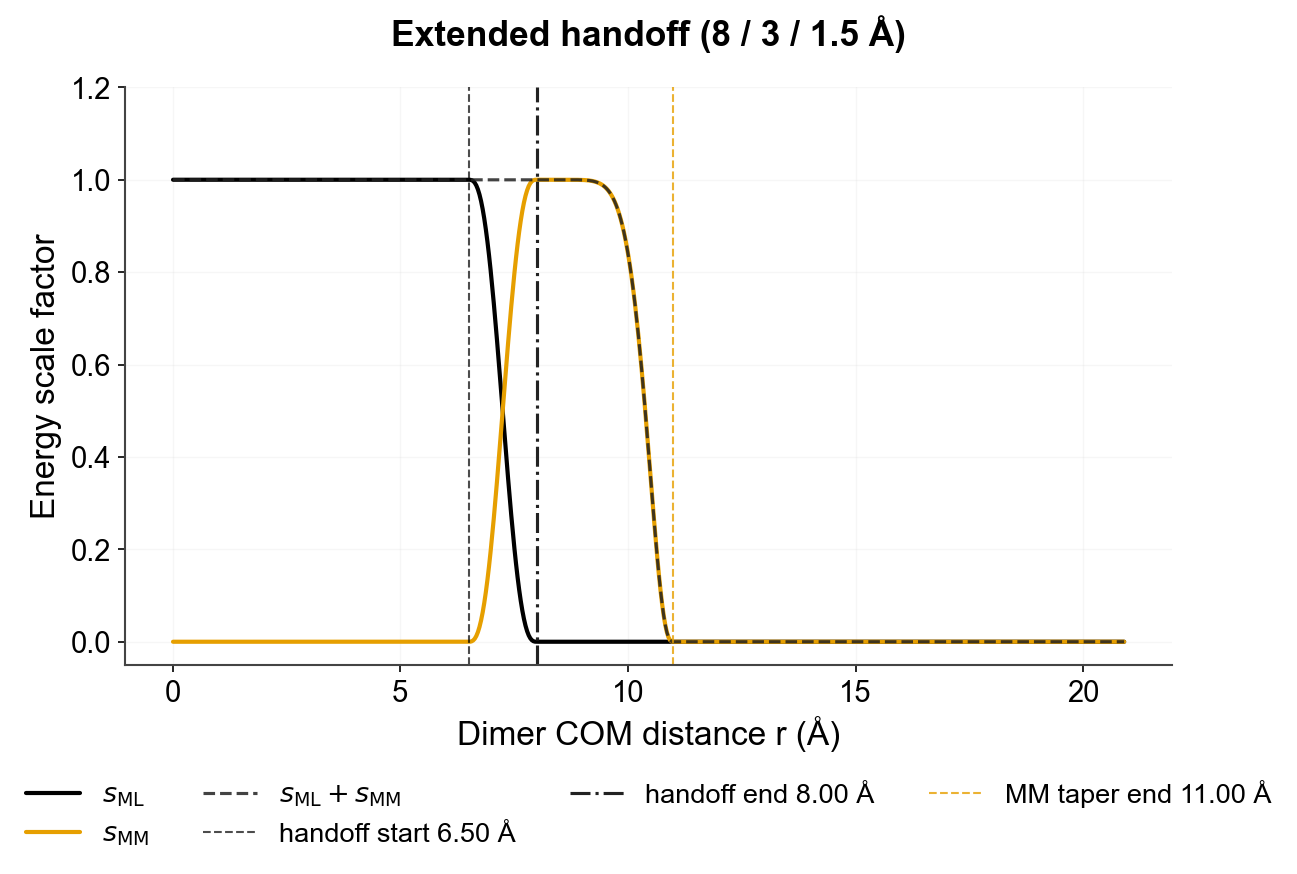
| Extended handoff (narrow MM) | 8.0 | 3.0 | 1.5 | Example; unstable on some DCM:3 geoms |
Production default (June 2026): extended_mm5 (8 / 5 / 1.5 Å) from the DCM:3 NVE cutoff sweep (workflows/dcm3_nve_cutoff_sweep, 5 ps validation). Lowest sane mean smoothness across all four trimer COM geometries. Legacy 7 / 5 / 0.1 remains a safe fallback if needed.
Overlay comparison
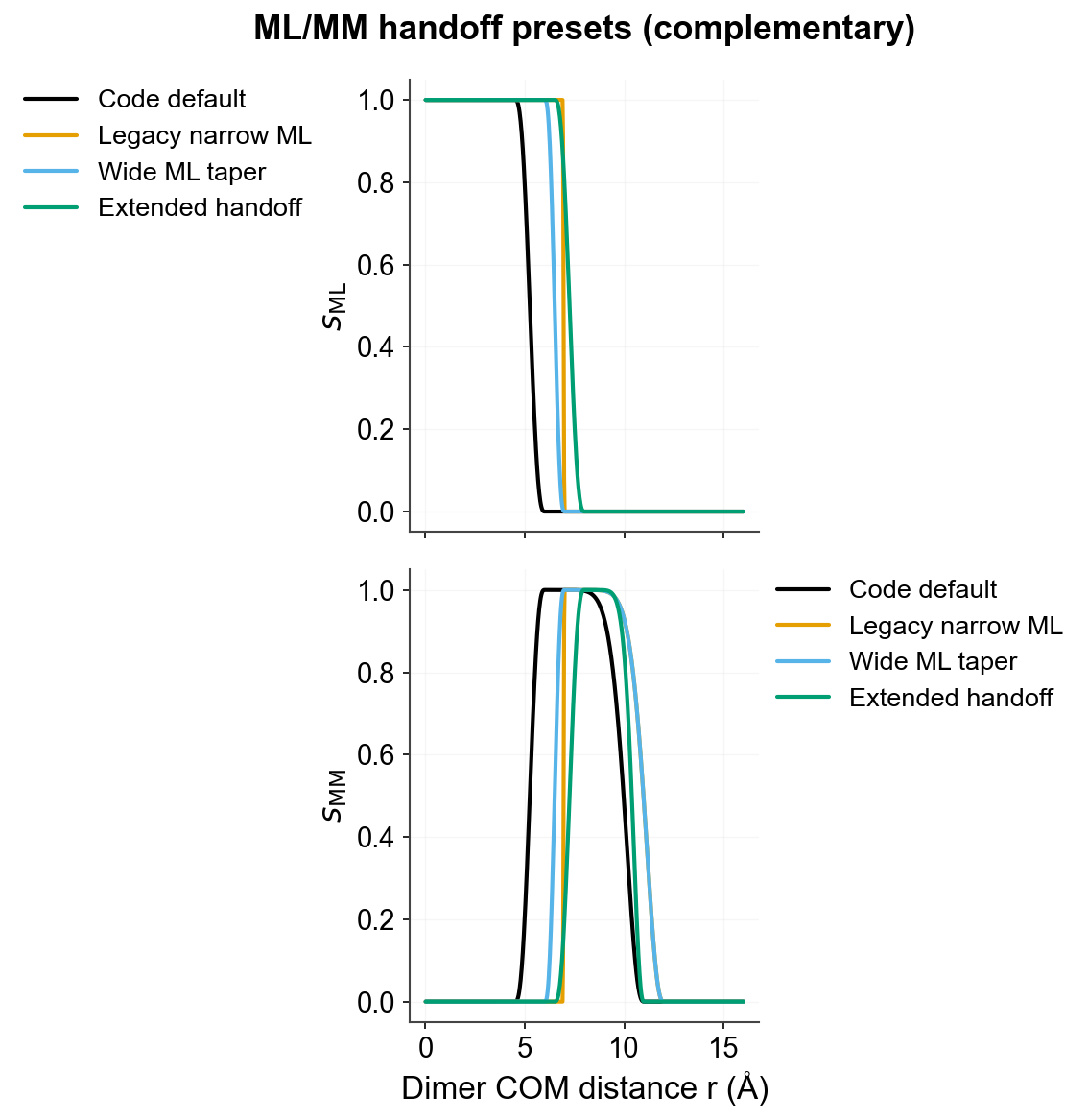
Per-preset schematics
Code default (8 / 5 / 1.5 Å) — extended_mm5
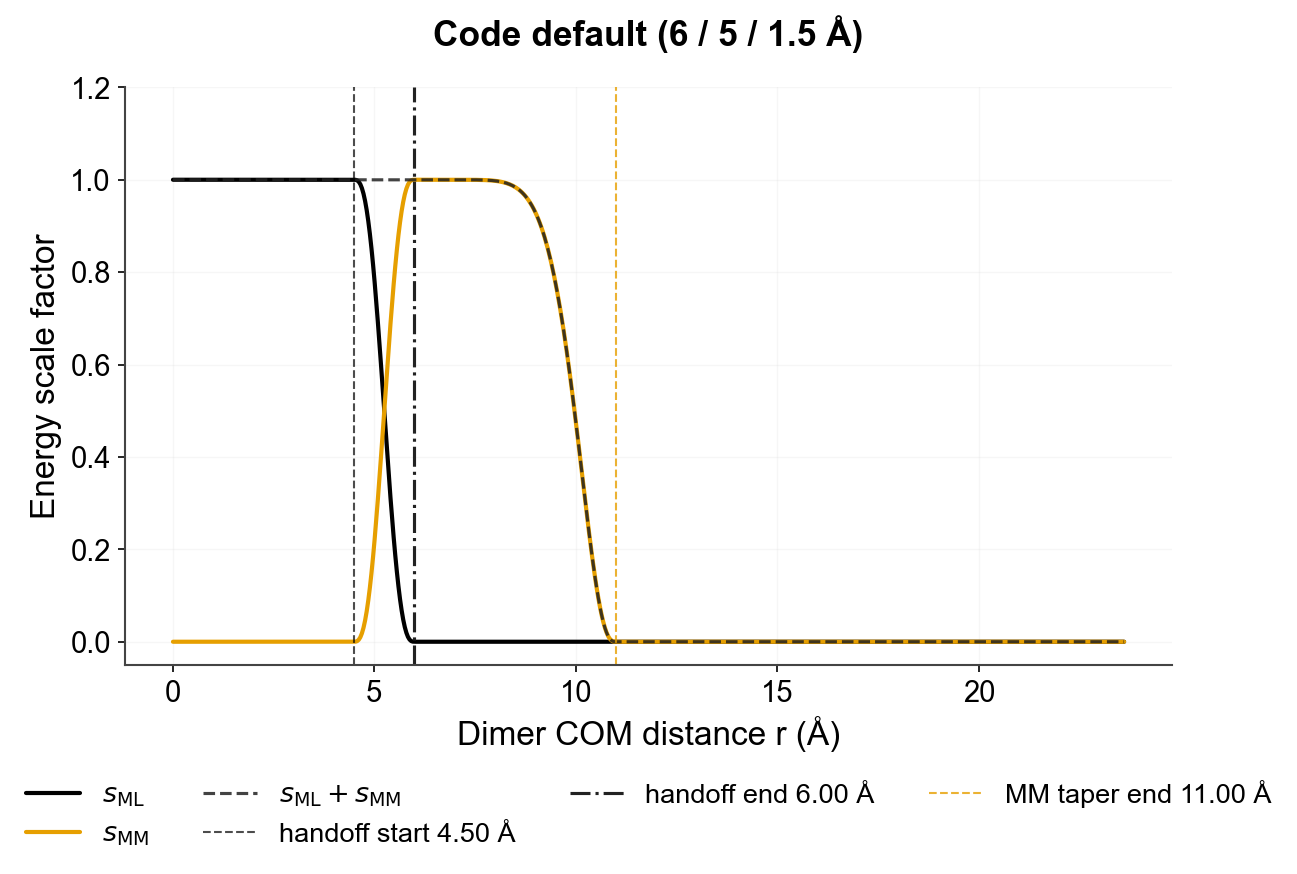
Legacy narrow ML (7 / 5 / 0.1 Å) — previous default
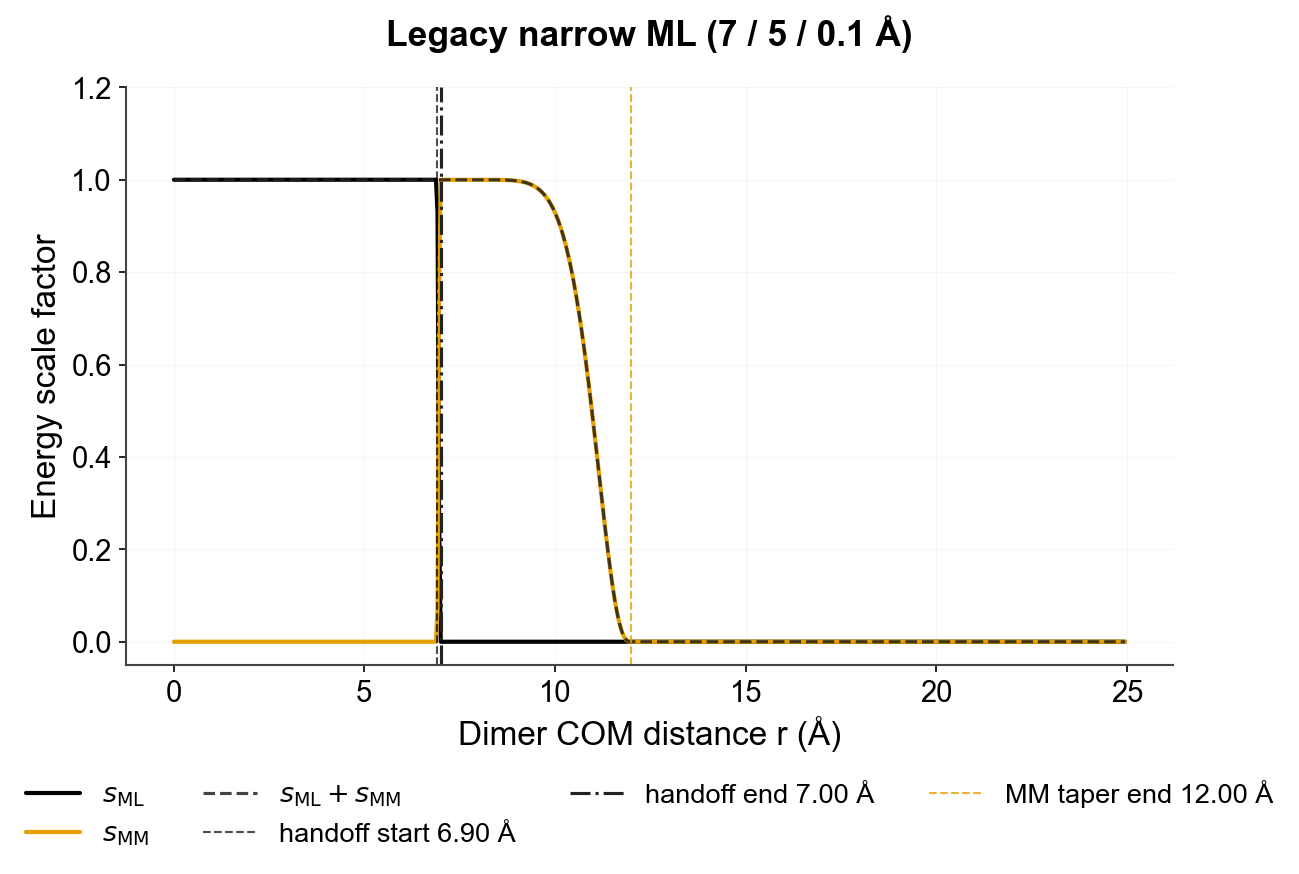
Sparse ML dimer evaluation uses COM distance < mm_switch_on (8 Å with current default). The switched MM neighbor-list reach is mm_switch_on + mm_switch_width (13 Å with current defaults).
Wide ML taper (7 / 5 / 1.0 Å)
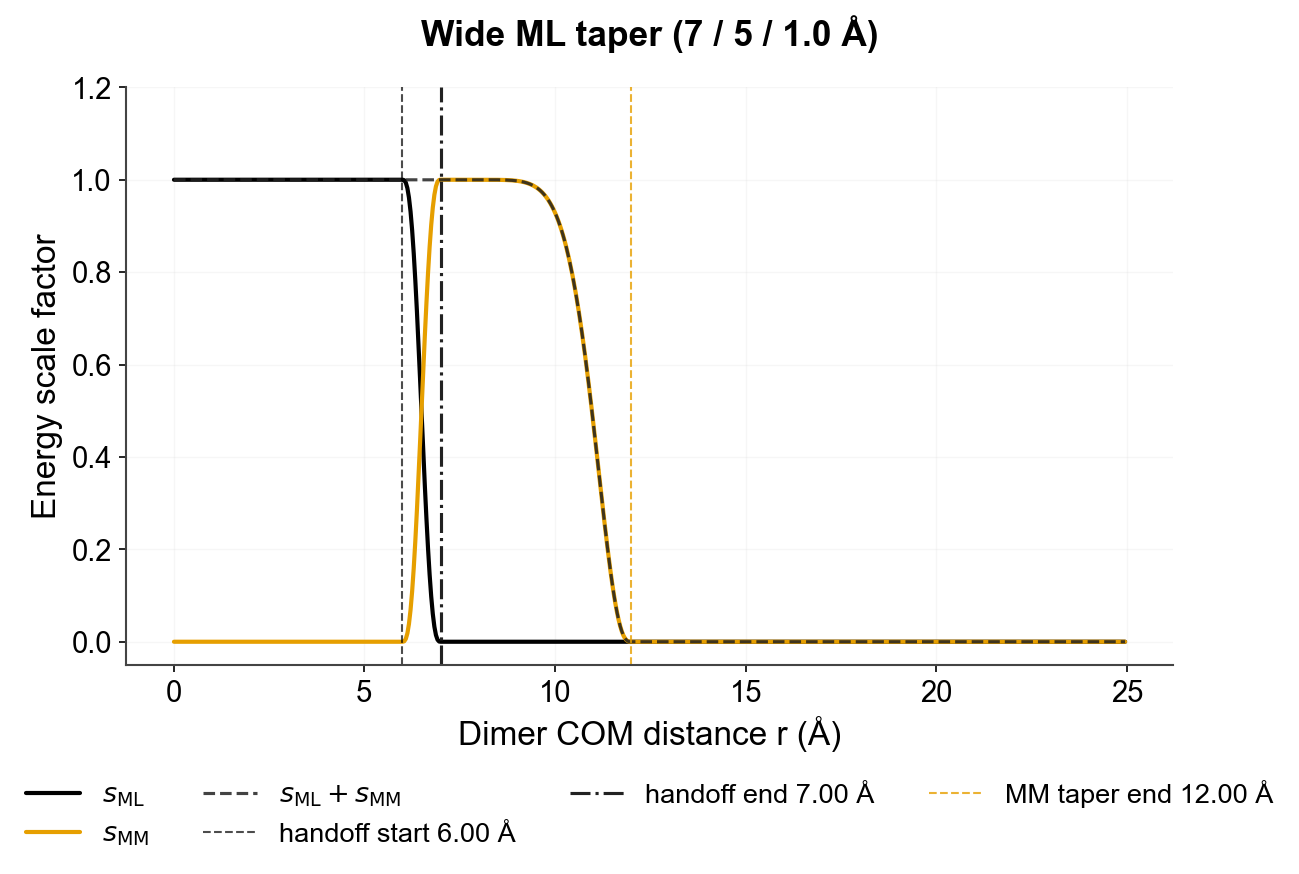
Extended handoff (8 / 3 / 1.5 Å)
Complementary vs legacy MM window
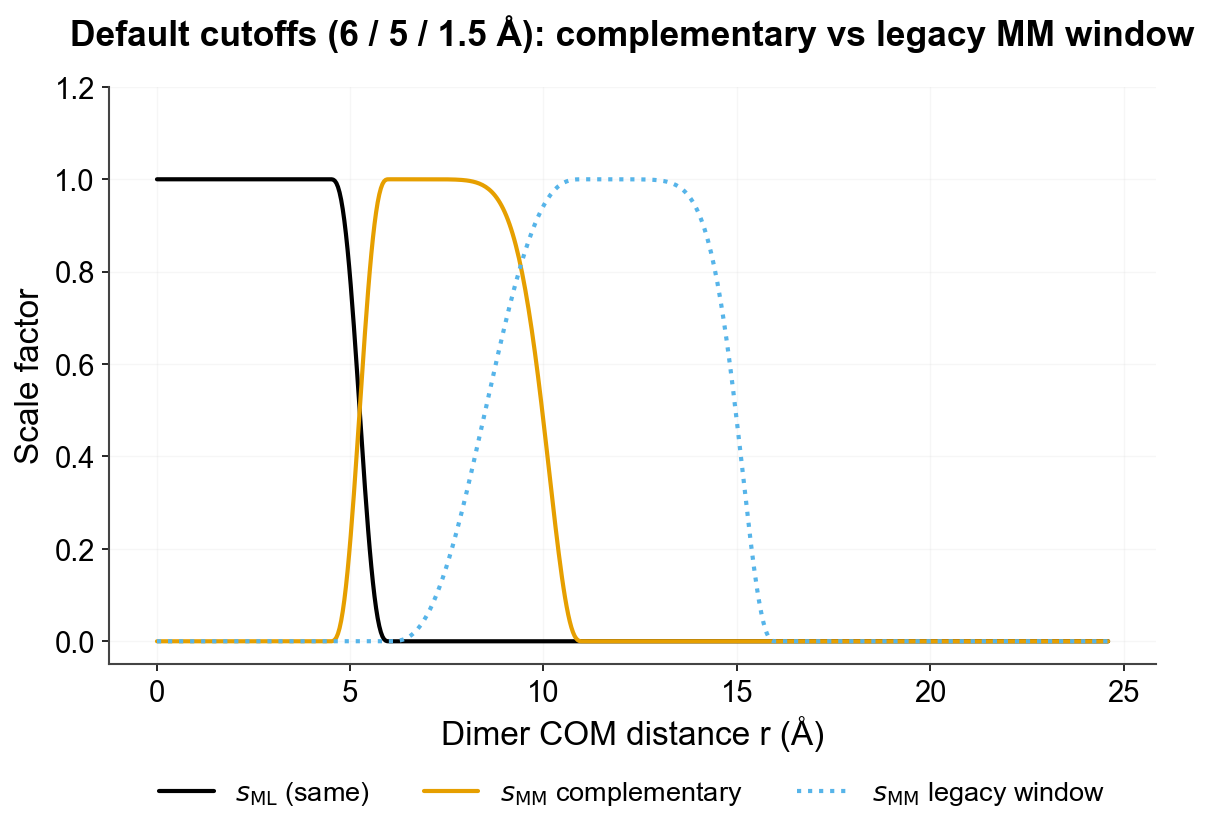
Default runs use complementary handoff. Legacy (--no-complementary-handoff) uses a separate MM window:
s_MM_legacy(r) =
  sharpstep(r, mm_switch_on, mm_switch_on + mm_switch_width, GAMMA_ON) *
  (1 - sharpstep(r, mm_switch_on + mm_switch_width,
                    mm_switch_on + 2 * mm_switch_width, GAMMA_OFF))
Legacy mode is not recommended for new workflows because MM is still zero throughout the ML taper interval. That creates a handoff gap unless another term covers that region.
Staged heating
--n-heat-segments N splits --ps-heat into short chained restarts with overlap rescue between segments. DCM:9 script default: N=4 (20 ps → 5 ps per segment, 0→240 K ramp).
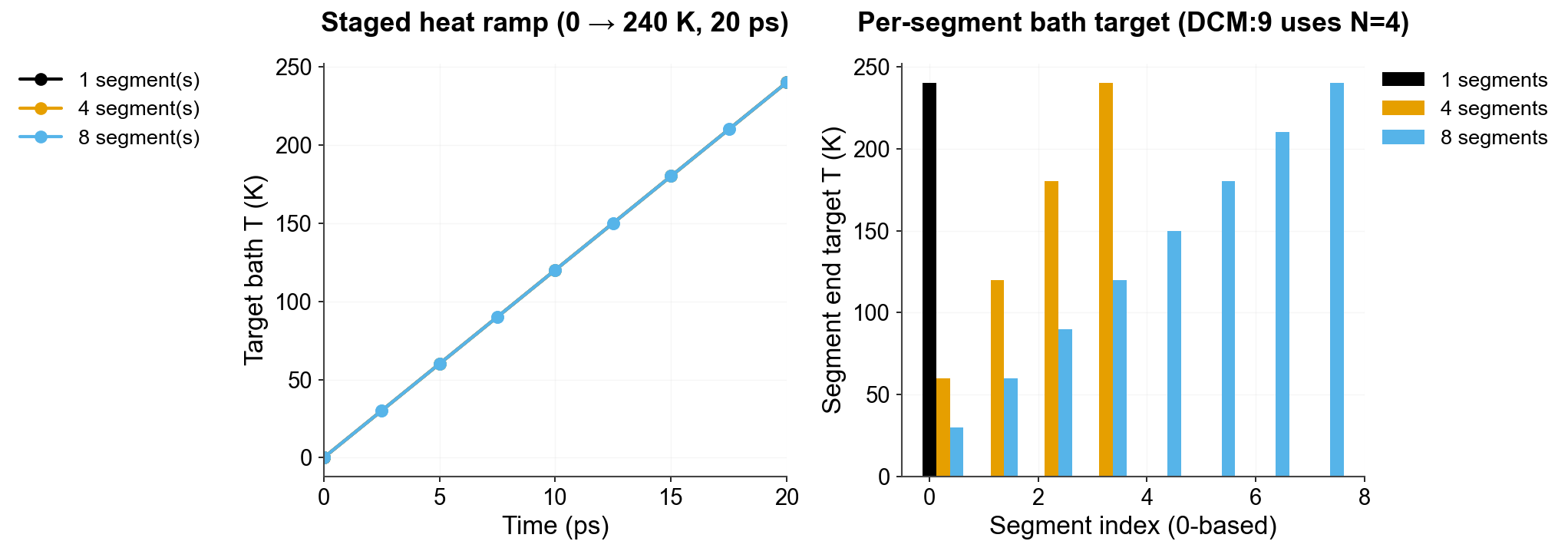
| Segments | ps per segment | Segment end targets (K) |
|---|---|---|
| 1 | 20.0 | 240 |
| 4 | 5.0 | 60, 120, 180, 240 |
| 8 | 2.5 | 30, 60, …, 240 |
Example:
./scripts/run_dcm9_stability.sh
# or
mmml md-system ... --n-heat-segments 4 --ps-heat 20 \
  --heat-firstt 0 --heat-finalt 240
# cutoffs default to --mm-switch-on 8 --mm-switch-width 5 --ml-switch-width 1.5
ML compute dtype (float32 vs float64)
PhysNet checkpoints are stored in float32. The hybrid calculator evaluates ML/MM interior math in a single JAX dtype (default float32). CHARMM I/O and returned total energies/forces stay float64.
Precedence: --ml-compute-dtype → MMML_ML_DTYPE → JAX_ENABLE_X64=1 → float32.
To run ML interior in float64 (experimental; model not re-validated in f64):
export JAX_ENABLE_X64=1
mmml md-system ... --ml-compute-dtype float64
# or: export MMML_ML_DTYPE=float64  (with JAX_ENABLE_X64=1)
JAX_ENABLE_X64 must be set before Python starts (e.g. in the shell or scripts/mmml-charmm-mpirun.sh). f32 checkpoints are promoted to f64 on load when f64 is requested.
If you saw smoother heating with “XLA” enabled, that was likely JAX_ENABLE_X64=1, not XLA_FLAGS compiler options alone — explicit dtype=jnp.float32 in the ML path previously blocked x64 until this centralization.
Medium PBC dense liquids (500–2000 monomers)
Before long production runs on equilibrated periodic boxes, validate the sparse dimer cap:
python scripts/validate_mlpot_sparse_dimers.py \
  --crd path/to/mini_full_mlpot_TAG.crd \
  --n-monomers 1000 --atoms-per-monomer 10 --box-size 40
See Medium PBC workflow for caps, ml_batch_size defaults, and JAX-MD handoff.