Structure building (make-res, make-box, build-crystal)
MMML builds molecular geometry in three layers: single residues (CGENFF + PyCHARMM), dense periodic boxes (Packmol + CHARMM), and symmetry-aware crystals (PyXtal).
Figures below are generated by scripts/generate_docs_figures.py using ASE
orthographic projection (plot_atoms / Matplotlib writer), covalent bonds
(natural_cutoffs neighbor list), Jmol colors, and matplotlib (static PNGs for
MkDocs — regenerate locally after changing the script).
uv run python scripts/generate_docs_figures.py
Overview
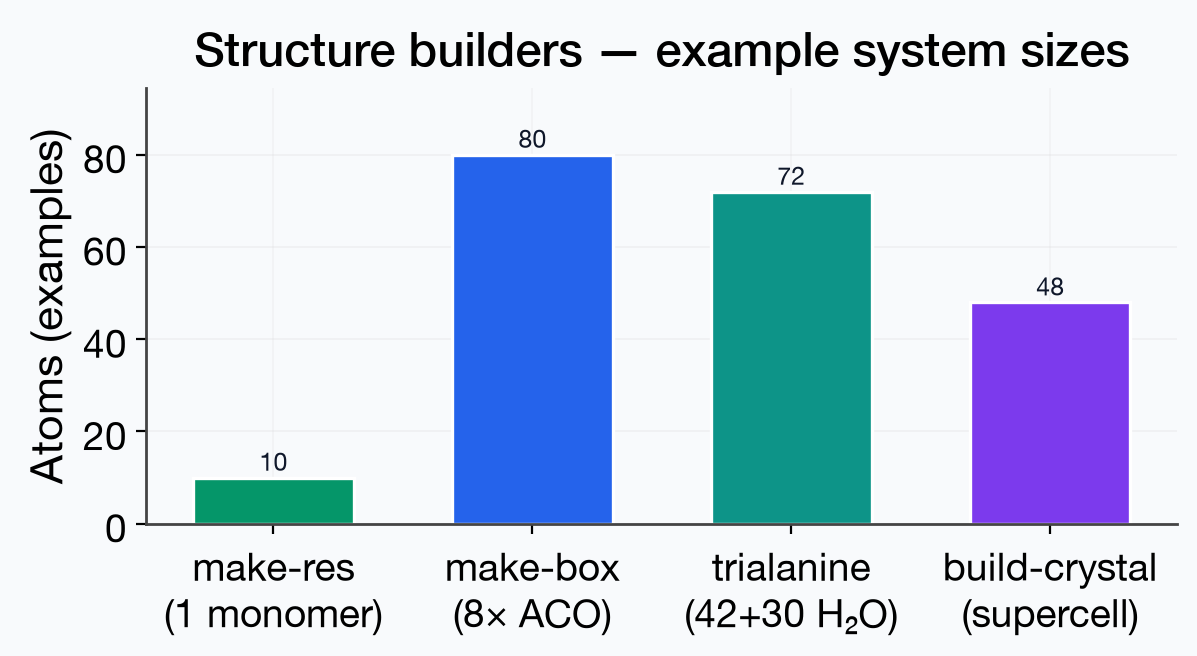
| Command | Input | Output | Backend |
|---|---|---|---|
make-res |
CGENFF residue name | pdb/, psf/, xyz/ |
PyCHARMM |
liquid-box |
Composition + density target | Certified MM liquid box | Packmol + CHARMM |
md-embedding |
aaa.ama NPZ + checkpoint | Solvated peptide partial MLpot | TRIA box + PhysNet |
build-crystal |
Literature CIF + make-res or SMILES/XYZ | .pdb, .xyz, .cif, .npz |
CIF mapper / PyXtal |
| Protein MM (CHARMM + jax-md) | protein-force-fields.md | ALAD PDB/PSF, JAX energies | PyCHARMM + jax-md |
mmml make-res
Generates one CGENFF residue with internal coordinates, minimization, and CHARMM topology files.
mmml make-res --list-residues
mmml make-res --res ACO --skip-energy-show
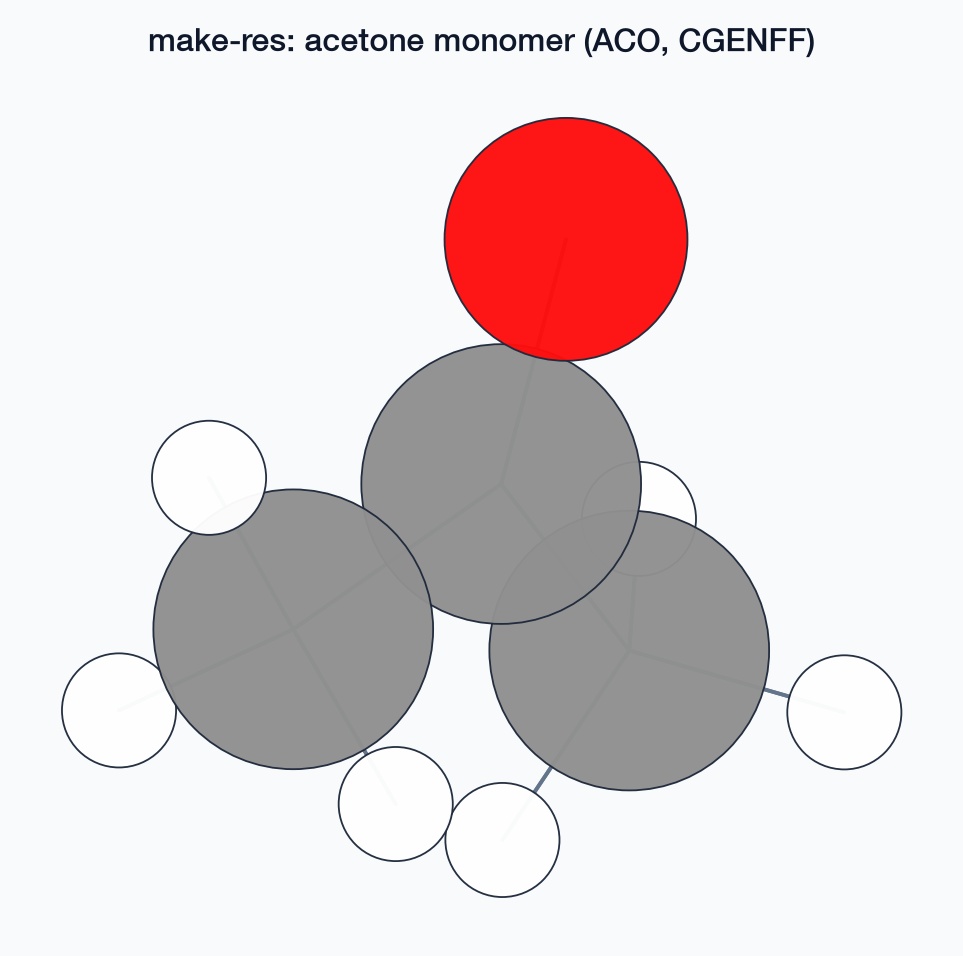
The plot uses the same bundled geometry as cluster builders (aco_monomer.pdb).
After make-res, coordinates land in xyz/<resi>.xyz and pdb/<resi>.pdb.
Regenerating the figure (ASE)
Orthographic view with bonds (same approach as the doc generator):
import matplotlib
matplotlib.use("Agg")
import numpy as np
import ase.io
import matplotlib.pyplot as plt
from ase.neighborlist import natural_cutoffs, neighbor_list
from ase.visualize.plot import Matplotlib
from matplotlib.collections import LineCollection
from mmml.paths import default_aco_template_pdb

atoms = ase.io.read(default_aco_template_pdb())
fig, ax = plt.subplots(figsize=(6.5, 5), dpi=150, facecolor="#f8fafc")
writer = Matplotlib(atoms, ax, rotation="25x,15y,0z", radii=0.88, scale=42)
i, j = neighbor_list("ij", atoms, natural_cutoffs(atoms, mult=1.08))
pos_i = atoms.positions[i]
pos_j = atoms.positions[j]
seg = np.stack([
    writer.to_image_plane_positions(pos_i)[:, :2],
    writer.to_image_plane_positions(pos_j)[:, :2],
], axis=1)
ax.add_collection(LineCollection(seg, colors="#64748b", linewidths=1.3, zorder=1))
# ... add atom circles via make_patch_list(writer), then savefig
mmml make-box
Packs copies of a residue into a cubic periodic cell (optionally with explicit solvent). Uses Packmol for initial placement.
mmml make-res --res ACO
mmml make-box --res ACO --n 50 --box-size 25.0
Solvation (--solvent)
--solvent accepts any CGenFF RESI from top_all36_cgenff.rtf (same names as
mmml make-res --list-residues). Common aliases: water → TIP3, octanol → OCOH.
Solvent monomer geometry is taken from a bundled template when available, else
from a prior make-res PDB in the working directory, else generated via
make-res. --density is in kg/m³; TIP3/water (1000) and OCOH/octanol (824)
have built-in defaults. Other solvents need an explicit density when sizing N
from density.
mmml make-res --res CYBZ --skip-energy-show
mmml make-box --res CYBZ --n 50 --box-size 25.0 --solvent TIP3
mmml make-box --res CYBZ --n 200 --box-size 30.0 --solvent MEOH --density 792
More Packmol examples
Mixed-solvent cube:
mmml make-res --res DCM --skip-energy-show
mmml make-res --res ACO --skip-energy-show
# Use md-system or liquid-box for multi-residue Packmol; make-box is single-residue.
mmml md-system --composition "DCM:30,ACO:10" --box-size 28.0 --no-packmol --builder liquid
PBC liquid with default Packmol (recommended):
export MMML_CKPT=/path/to/checkpoint.json
mmml md-system \
  --composition DCM:100 \
  --box-size 32.0 \
  --setup pbc_nvt \
  --md-stages mini \
  --output-dir /tmp/dcm100_packmol
Full Packmol reference: packmol-placement.md.
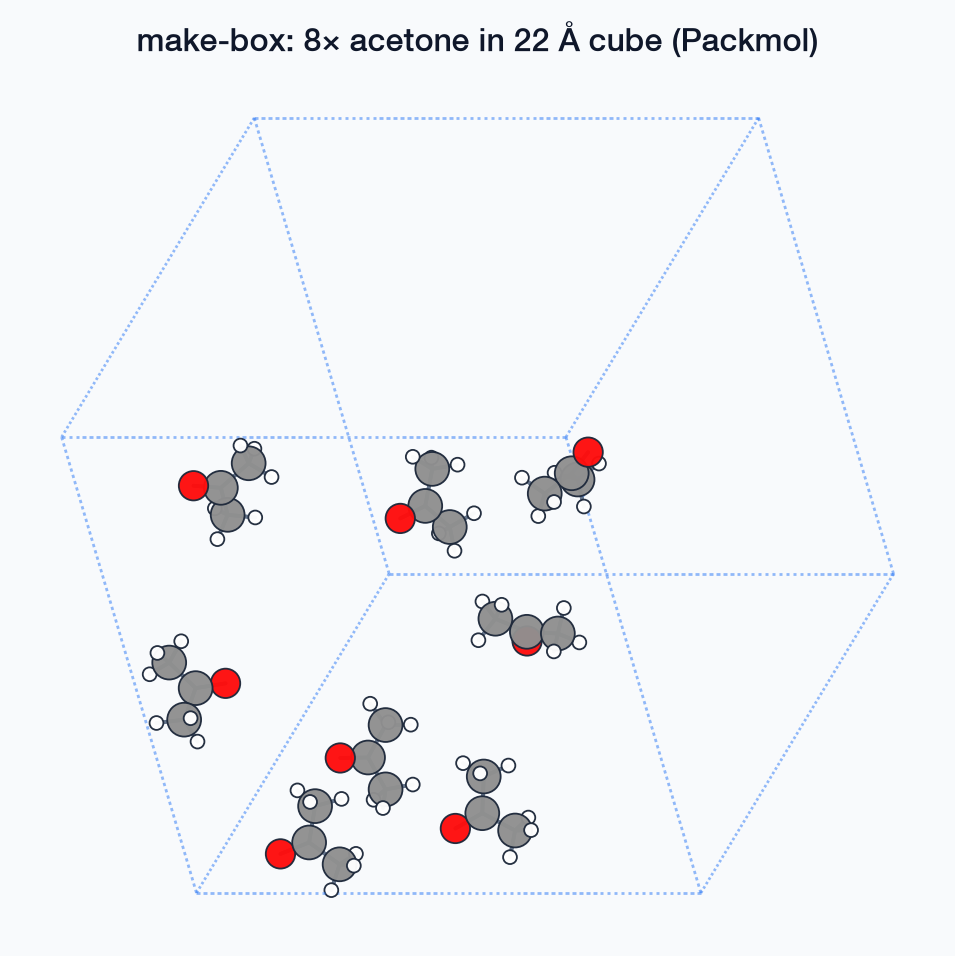
Packmol writes pdb/init-packmol.pdb; PyCHARMM then builds PSF, applies PBC, and
minimizes contacts. For production liquid workflows see
liquid-box workflow.
Regenerating the figure
The PNG uses a Packmol-packed 8× ACO / 22 Å cube committed as
mmml/data/structures/make-box-aco-8x22A.pdb (monomer from make-res / default_aco_template_pdb()).
uv run python scripts/export_docs_structure_assets.py   # Packmol + CHARMM exports
uv run python scripts/generate_docs_figures.py          # ASE orthographic PNG
mmml build-crystal
Build molecular crystals for MD: literature CIF + make-res (CHARMM atom names, simulation supercell) or PyXtal random placement with space-group symmetry.
DCM (CH₂Cl₂) — experimental crystal
The deposited structure at CCDC doi:10.5517/cc9lyjb (Podsiadło et al., Acta Cryst. B 2005, 61, 595; COD 2100015) is orthorhombic Pbcn (SG 60), Z=4, measured at 1.63 GPa / 293 K:
| Quantity | Value |
|---|---|
| a, b, c | 3.924, 7.793, 9.335 Å |
| ρ (experimental) | 1.972 g/cm³ |
| Low-T phase (153 K, 0.1 MPa) | same SG; a≈4.25, b≈8.14, c≈9.49 Å (Kawaguchi et al. 1973) |
MMML ships the CIF as default_dcm_crystal_cif(). For MD, build a simulation
supercell with CHARMM atom names from make-res and literature geometry from
the bundled CIF (no PyXtal required). Supercell repeats default to ≥28 Å per
edge (≈2× CHARMM cutnb), preserving experimental density.
| Phase | Typical ρ (g/cm³) | MMML source |
|---|---|---|
| Liquid DCM | 1.326 | liquid-box, md-system |
| Crystal (this CIF) | 1.972 | --literature dcm / bundled CIF |
# 1) CHARMM residue with correct atom names (once per force field)
mmml make-res --res DCM --skip-energy-show

# 2) Literature unit cell → simulation supercell (auto repeats for box size)
mmml build-crystal --literature dcm \\
  --monomer-pdb pdb/dcm.pdb \\
  -o pdb/dcm_crystal.pdb

# Explicit supercell and ASE handoff
mmml build-crystal --literature dcm --supercell 4,4,3 \\
  -o dcm_super.extxyz
PyXtal random placement (-m + --spg 60) is optional when you want an
alternate trial cell with the same space group and target density:
# Experimental unit cell only (ASE)
python -c "
from ase.io import read, write
from mmml.paths import default_dcm_crystal_cif
write('dcm_expt.extxyz', read(default_dcm_crystal_cif()))
"

# PyXtal placement in Pbcn, scaled to experimental density
uv sync --extra chem
mmml build-crystal \\
  -m "$(python -c 'from mmml.paths import default_dcm_molecule_xyz; print(default_dcm_molecule_xyz())')" \\
  --spg 60 --z 4 \\
  --target-density-g-cm3 1.972 \\
  --seed 42 \\
  -o dcm_pyxtal.extxyz
PyXtal does not resolve C(Cl)Cl SMILES — use the bundled monomer XYZ or
mmml make-res --res DCM export.
Benzene (C₆H₆) — experimental crystal
High-pressure benzene I is monoclinic P2₁/c (SG 14), Z=2
(COD 4501704;
Katrusiak et al., Cryst. Growth Des. 2010, 10, 3461).
MMML ships default_benzene_crystal_cif().
mmml make-res --res BENZ --skip-energy-show
mmml build-crystal --literature benz --monomer-pdb pdb/benz.pdb \\
  -o pdb/benz_crystal.pdb
PyXtal accepts the molecule name benzene (not SMILES c1ccccc1) for
random placement:
# Experimental unit cell
python -c "
from ase.io import read, write
from mmml.paths import default_benzene_crystal_cif
write('benzene_expt.extxyz', read(default_benzene_crystal_cif()))
"

# PyXtal placement in P2₁/c, density matched to literature
mmml build-crystal -m benzene --spg 14 --z 2 \\
  --target-density-g-cm3 1.202 --seed 7 -o benzene_pyxtal.extxyz
Literature cross-check (auto-generated)
Bundled experimental CIFs vs make-res+CIF (exact literature unit cell, CHARMM atom names) and a single PyXtal from_random trial (fixed seeds) with ρ scaled to literature. PyXtal unit-cell axes can differ in setting/orientation even when space group and density agree.
Regenerate: uv run python scripts/generate_crystal_lit_compare.py
DCM (CH₂Cl₂) — COD 2100015
Podsiadło et al., Acta Cryst. B 2005, 61, 595 (CCDC doi:10.5517/cc9lyjb); Pbcn, Z=4, 1.63 GPa / 293 K.
| Quantity | Literature | make-res+CIF | Δ (CIF−lit) | PyXtal build | Δ (PyXtal−lit) |
|---|---|---|---|---|---|
| Space group | 60 | 60 | — | 60 | — |
| N atoms | 20 | 20 | +0.0% | 20 | +0.0% |
| a (Å) | 3.924 | 3.924 | +0.0% | 7.773 | +98.1% |
| b (Å) | 7.793 | 7.793 | +0.0% | 6.651 | -14.7% |
| c (Å) | 9.335 | 9.335 | +0.0% | 5.521 | -40.9% |
| α (°) | 90.0 | 90.0 | +0.0% | 90.0 | +0.0% |
| β (°) | 90.0 | 90.0 | +0.0% | 90.0 | +0.0% |
| γ (°) | 90.0 | 90.0 | +0.0% | 90.0 | +0.0% |
| Volume (ų) | 285.5 | 285.5 | +0.0% | 285.5 | +0.0% |
| ρ (g/cm³) | 1.976 | 1.976 | +0.0% | 1.976 | -0.0% |
make-res+CIF: mmml build-crystal --literature dcm (unit cell).
PyXtal: -m default_dcm_molecule_xyz(), --spg 60 --z 4 --seed 42, ρ scaled to literature.
Benzene (C₆H₆) — COD 4501704
Katrusiak et al., Cryst. Growth Des. 2010, 10, 3461 (doi:10.1021/cg1002594); P2₁/c, Z=2, ~0.97 GPa / 295 K.
| Quantity | Literature | make-res+CIF | Δ (CIF−lit) | PyXtal build | Δ (PyXtal−lit) |
|---|---|---|---|---|---|
| Space group | 14 | 14 | — | 14 | — |
| N atoms | 24 | 24 | +0.0% | 24 | +0.0% |
| a (Å) | 5.522 | 5.522 | +0.0% | 5.175 | -6.3% |
| b (Å) | 5.440 | 5.440 | +0.0% | 11.337 | +108.4% |
| c (Å) | 7.673 | 7.673 | +0.0% | 3.813 | -50.3% |
| α (°) | 90.0 | 90.0 | +0.0% | 90.0 | +0.0% |
| β (°) | 110.6 | 110.6 | +0.0% | 74.7 | -32.4% |
| γ (°) | 90.0 | 90.0 | +0.0% | 90.0 | +0.0% |
| Volume (ų) | 215.8 | 215.8 | +0.0% | 215.8 | -0.0% |
| ρ (g/cm³) | 1.202 | 1.202 | +0.0% | 1.202 | -0.0% |
make-res+CIF: mmml build-crystal --literature benz (unit cell).
PyXtal: -m benzene (not c1ccccc1), --spg 14 --z 2 --seed 7, ρ scaled to literature.
Other examples
mmml build-crystal -m benzene --spg 14 --z 2 -o benzene.extxyz
mmml build-crystal -m monomer.xyz --spg 4 --supercell 2,2,2 -o super.cif
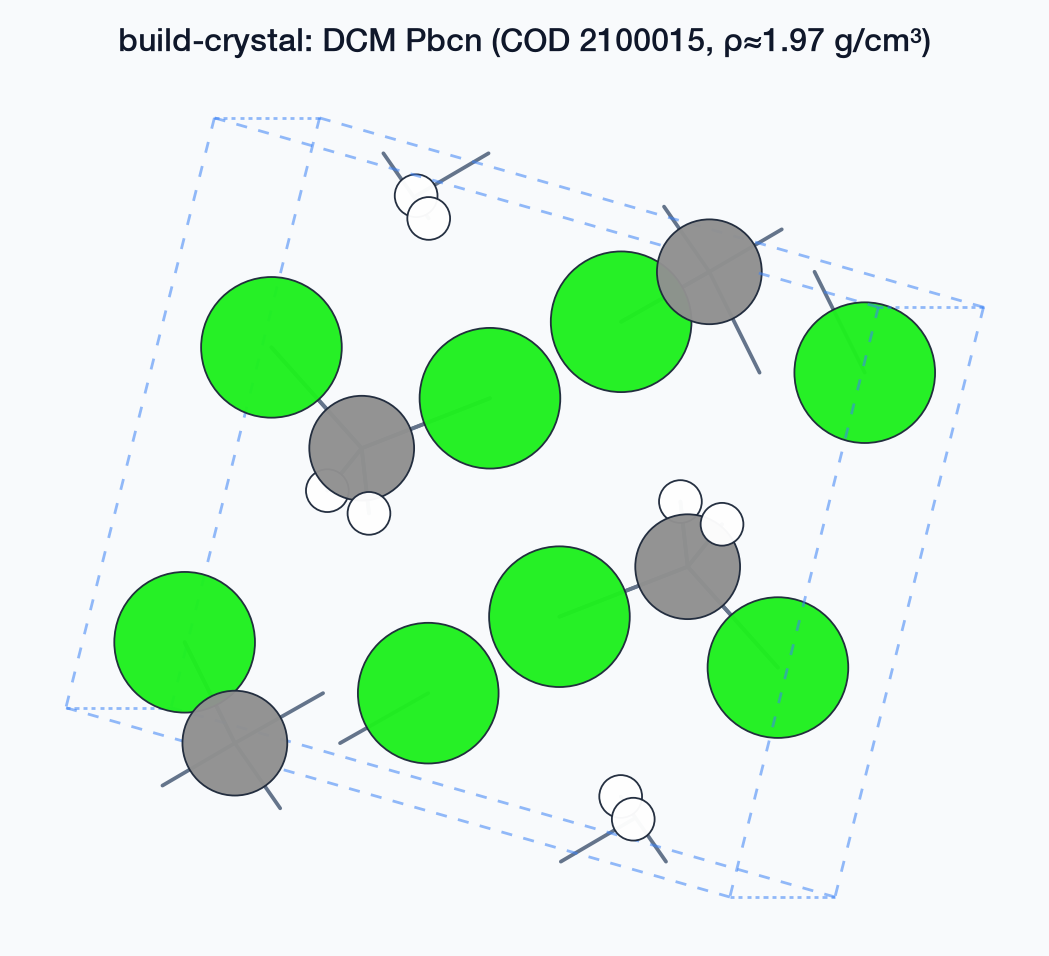
The doc figure uses the bundled COD 2100015 coordinates when ASE is available. Without the CIF, the generator falls back to PyXtal (Pbcn) or the bundled benzene P2₁/c CIF (COD 4501704).
See also: PyXtal tests on GitHub.
Related: liquid-box density prep
Phase-A liquid certification uses MM-only prep before MLpot. The ladder below is a schematic matplotlib plot (not from a live run):
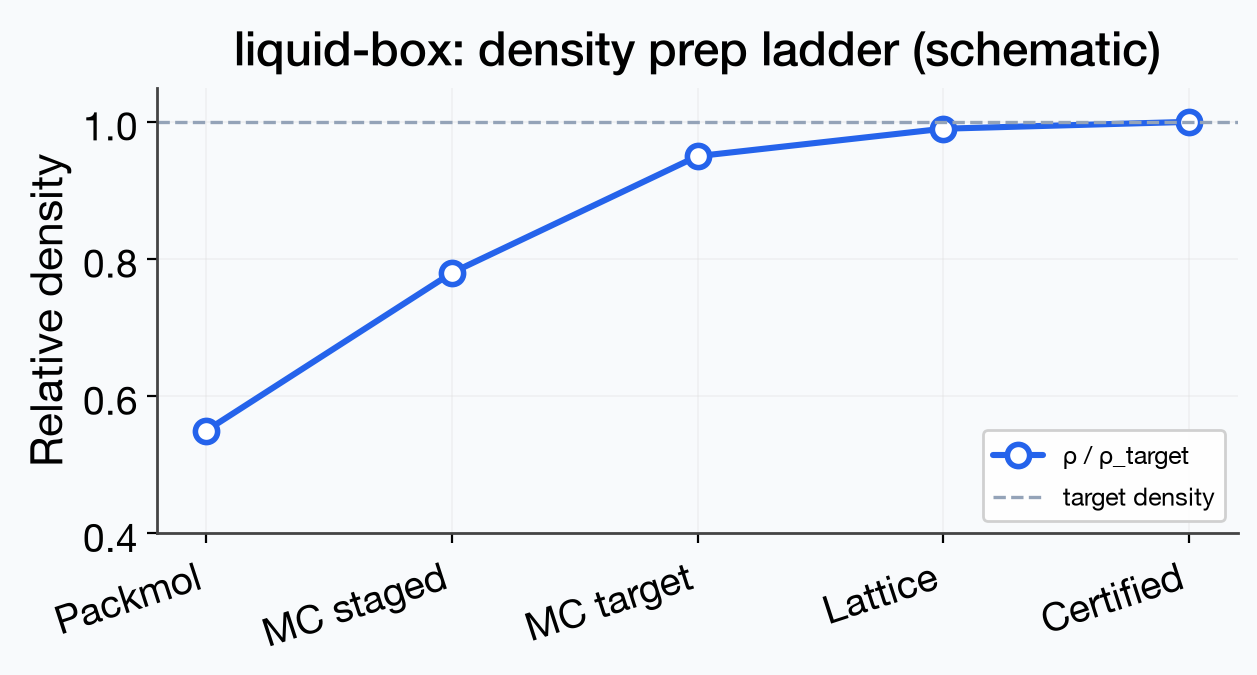
import matplotlib.pyplot as plt

stages = ["Packmol", "MC staged", "MC target", "Lattice", "Certified"]
density = [0.55, 0.78, 0.95, 0.99, 1.00]
fig, ax = plt.subplots()
ax.plot(stages, density, "o-")
ax.axhline(1.0, linestyle="--", color="gray")
ax.set_ylabel("ρ / ρ_target")
fig.savefig("liquid-box-density-ladder.png")
Full workflow: liquid-box-workflow.md.
See also
- CLI overview
- md-system YAML configs — campaigns that consume certified boxes
- Regenerate figures (
uv run python scripts/generate_docs_figures.py)