md-system / cg_jaxmd: capabilities checklist¶
A stakeholder-facing summary of what the experimental unified mmml/md/ stack
(built to merge md-system and cg_jaxmd — see the
full design doc and
handoff notes) can do today, with runnable
examples and real-structure diagrams. Status marks: ✅ done & tested, 🚧 partially
done, ⬜ planned / not started.
1. Capability checklist¶
Harmonization decision and remaining gap matrix¶
The canonical destination is not to copy every cg_jaxmd flag into a
second md-system implementation. The ownership decision is:
cg_jaxmd JSON ─┐
               ├─ lowering → RunConfig → MolecularSystem → HybridEnergy
md-system CLI ─┘                                      ↓
                              JaxmdDriver | RigidBodySampler
mmml.md owns system state, terms, neighbor policy, drivers, samplers, and
results. mmml md-system becomes the supported CLI. A cg-style JSON file is a
compatibility input format lowered into RunConfig, not a second runtime.
examples/cg_jaxmd.py remains a frozen scientific reference until parity is
demonstrated, then becomes a thin compatibility wrapper or is deprecated.
| Capability | Legacy cg_jaxmd.py |
Shared mmml.md core |
md-system --jaxmd-unified |
Required harmonization action |
|---|---|---|---|---|
| FIRE, NVE, NVT-NHC | ✅ | ✅ | ✅ | Remove the opt-in flag after the remaining acceptance gates pass. |
| NPT | — | ✅ | ✅ | Keep only the shared JaxmdDriver implementation. |
| Rigid-body MC | — | ✅ | ✅ | Keep as RunConfig.sampler, independent of front end. |
| ML intramolecular + MM nonbonded | ✅ | ✅ | ✅ | Shared terms are canonical. |
| ML peptide–water interaction | ✅ | ✅ | ⬜ | Expose the peptide-water builder and ml_pep_water term through md-system. |
| Core–water repulsive VDW wall | ✅ | ✅ | ⬜ | Expose vdw_core term options through the same typed term configuration. |
| SMD bias energy | ✅ | ✅ | ⬜ | Expose smd term configuration; keep pulling schedules/work analysis as a protocol layer. |
| φ/ψ restraint energy | ✅ | ✅ | ⬜ | Add a topology-based dihedral-index resolver, then expose the existing dihedral term. |
| Separate peptide/water checkpoints | ✅ | Context supports one model today | ⬜ | Generalize EnergyContext to named model providers keyed by molecular role. |
| Peptide/water electrostatic embedding | ✅ | ⬜ | ⬜ | Implement a registered embedding term/provider; do not hide it inside the driver. |
| ML charge-total correction | ✅ | Charge machinery exists elsewhere | ⬜ | Reuse the canonical charge-mode/neutralization primitives and record the resolved charge policy. |
| Temperature schedule | ✅ | Driver has fixed target | ⬜ | Add a serializable schedule to EnsembleSpec; driver consumes it without CLI-specific logic. |
| Continuous FIRE→NVT→NVE state | ✅ | Trajectory carries positions only between wrapper phases | ⬜ | Define a restart state containing positions, velocities/momenta, box, RNG, step, and integrator state. |
| H–X bond and staged CHARMM/ML repair | ✅ | Driver has an overlap-repair hook, not feature parity | ⬜ | Define a RecoveryPolicy hook with event records; keep CHARMM-specific repair in an adapter. |
| DCD + ASE trajectory output | ✅ | NPZ/trajectory result exists | Partial | Add output-writer plugins consuming the shared trajectory; no driver-specific writing. |
| Detailed force/energy/neighbor diagnostics | ✅ | Per-term energy composition exists | Partial | Add observers/reporters at block boundaries; diagnostics must not live in the integration loop. |
| Packmol composition builder | Different path | ✅ | ✅ | Canonical for general liquids. |
| Peptide + water builder | ✅ | ✅ | ⬜ | Wire into md-system; remove trialanine-specific assumptions incrementally. |
| PSF, template-PDB, PyXtal builders | Legacy md-system has variants |
Builders exist | ⬜ | Route all through the builder registry before making unified mode default. |
--continue-from handoff |
Legacy paths | ⬜ | ⬜ | Implement the shared restart-state schema first; avoid format-specific shortcuts. |
| PME/ScaFaCoS in jitted dynamics | Some separate paths | ASE face only | ⬜ | Supply a genuinely JAX-traceable LR term; never silently fall back to MIC. |
The largest missing scientific capabilities are electrostatic embedding, role-specific checkpoints, and explicit charge correction. The largest operational gaps are restart/state continuity, recovery policy, output writers, and observers. Builder wiring is mostly integration work.
Acceptance gates for retiring the duplicate runtimes¶
md-systemcan select every registered builder without leaving the sharedRunConfig → assemble_and_runpath.- cg-style energy modes lower to the same named terms and produce energy/force parity on frozen frames.
- Phase transitions preserve the complete restart state, not positions alone.
- Electrostatic embedding, charge policy, role-specific models, restraints, and SMD are explicit serialized configuration.
- Recovery and diagnostics emit structured events and do not modify physics silently.
- Output trajectories round-trip positions, velocities, box, energies, forces, term decomposition, and provenance.
- Cross-backend tests cover FIRE/NVE/NVT/NPT, the peptide-water mixed system, and at least one restart at a block boundary.
- Production comparison runs meet documented energy-drift, temperature, structural, and performance tolerances.
After these gates, make the shared path the default, retain a temporary
--legacy-jaxmd escape hatch with a removal date, point the cg workflow at the
compatibility lowering adapter, and freeze examples/cg_jaxmd.py against new
features.
Shared calculator & builder architecture¶
The historical split — md-system speaking ASE Calculator objects,
cg_jaxmd hand-composing a jax-md energy_fn — now has one shared stack
available to both front-ends through their opt-in routes.
- ✅ One config object (
RunConfig) for both themd-systemCLI and thecg_jaxmdSnakemake JSON — no more drifting configs. - ✅ One immutable system representation (
MolecularSystem+FFParams) that every builder produces and every energy term reads — charges, LJ tables, exclusions resolved once by CHARMM, never recomputed at runtime. - ✅ Four system builders share one interface: PSF (from an existing CHARMM PSF), Packmol (liquid boxes), PyXtal (molecular crystals), and peptide + water (a trialanine/TIP3 CGENFF builder).
- ✅ All six physics terms extracted into standalone, independently parity-tested modules: ML intramolecular, ML peptide–water dimer, classical MM nonbonded, repulsive core wall, steered-MD bias, backbone dihedral restraint.
- ✅ One
HybridEnergythat composes selected terms and exposes both faces from the same definition: an ASECalculatorand a jittableenergy_fn(R)for jax-md. - ✅ One driver (
JaxmdDriver) covering minimization (FIRE), NVE, NVT (Nosé–Hoover), and NPT (Nosé–Hoover barostat) — replacing two independently-drifting integrator implementations. - 🚧 Both front-ends have an opt-in shared route:
mmml md-system --backend jaxmd --jaxmd-unifiedsupports only Packmol composition inputs, whileexamples/cg_jaxmd_unified.pysupports the trialanine/water configuration surface documented below. The legacy routes remain the defaults. - ✅ The shared modules have focused unit and optional live-CHARMM/checkpoint integration tests. The latter are skipped when their local dependencies are unavailable; do not read a test count as a deployment certification.
Mixed systems: one ML-scored core + explicit MM/ML solvent¶
The headline physics capability — a peptide scored by a neural-network potential, embedded in explicit water that is ML-scored nearby and classically scored further out, all evaluated through the same code path as a pure-ML or pure-MM run.
- ✅ Build a real system (CHARMM CGENFF): one ML "core" molecule + N TIP3
waters, lowered into one
MolecularSystem. - ✅ The trialanine/water front end can split energy into four terms in one
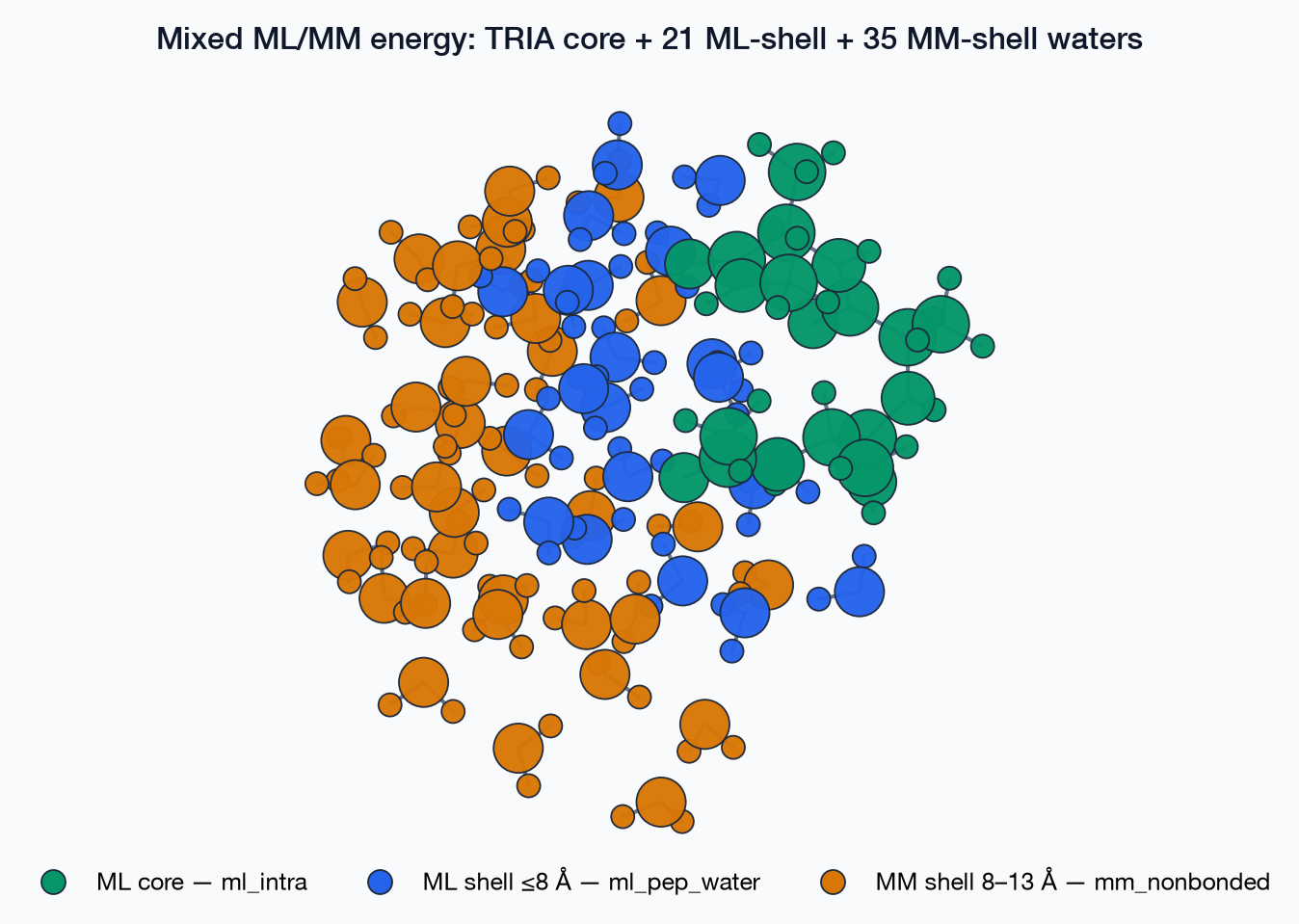
HybridEnergy: ML intramolecular (core,ml_intra) + ML dimer (core↔near-water,ml_pep_water) + repulsive wall (core↔far-water,vdw_core, keeps waters outside the ML shell from collapsing into the core unscored) + classical MM (water↔water,mm_nonbonded). - ✅ The trialanine/water front end accepts a checkpoint and the documented
energy-mode toggles. The
mixed_calculator_sweepworkflow contains the NVE validation setup for this route. - 🚧 Long-range electrostatics solvers (PME, ScaFaCoS) work for one-off ASE evaluation but are not yet wireable into the jitted MD loop.
- ⬜ A general "any small-molecule ML core" builder — today the peptide+water builder is specifically trialanine-shaped.
- ⬜ Dynamic hand-off of an individual water between "ML-scored" and "MM-scored" as it crosses the cutoff mid-trajectory — today the ML shell is fixed at build time, not re-evaluated every step.
Sampling & ensembles¶
- ✅
JaxmdDriverimplements minimization, NVE, NVT, and NPT; NPT requires a periodic box. Mixed-system NVT/NPT production validation remains open. - ✅ Rigid-body Monte Carlo sampler — moves whole monomers as rigid bodies
(translation + quaternion rotation) using the same energy and system, no
code fork. Selected by one config field (
sampler="rigid"). - ⬜ Structural validation (RDF) that rigid sampling reproduces the real liquid structure of flexible MD — needs a production force-field run.
Cluster deployment & validation¶
- 🚧 The repository includes SLURM-oriented workflows and an automated
unified_backend_sweep, but availability of CUDA, Packmol, PyCHARMM and the ML checkpoint is host-specific. Validate a target cluster before using the experimental route for production.
GPU-native CHARMM (apocharmm) — next major piece, design-complete¶
- ⬜ Not started. Design is settled (device-side ML forces via a custom
ForceManager, DLPack buffer transport, host-barrier sync first) — see design doc §4/§10 for the committed interface. Needs a CUDA build to begin.
2. What this looks like¶
Trialanine + TIP3 water snapshot from examples/atoms.pdb, colored by the
role used in the mixed-system decomposition. The role assignment is a static
distance-based illustration, not a trajectory-derived adaptive solvent shell:
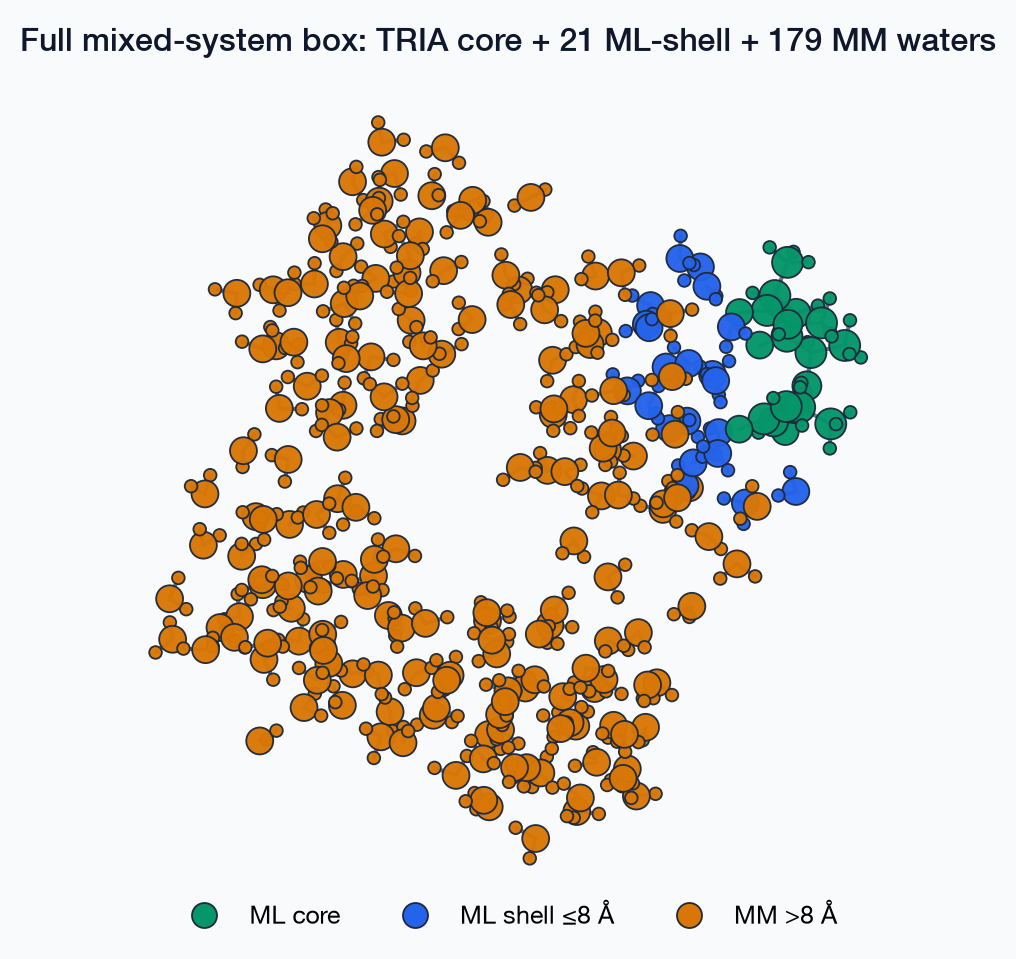
The same coloring over the full solvated box (200 waters), showing how small the ML-scored shell is relative to the classically-scored bulk — this is why the hybrid decomposition matters for cost:
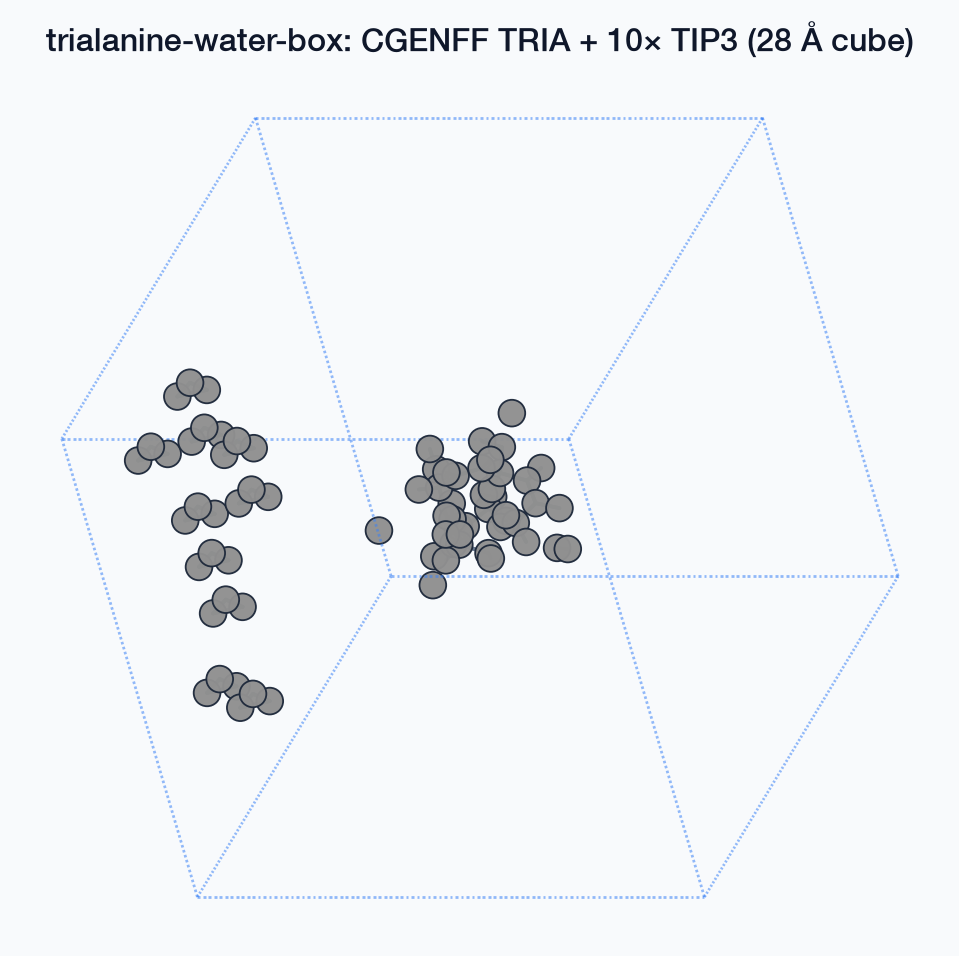
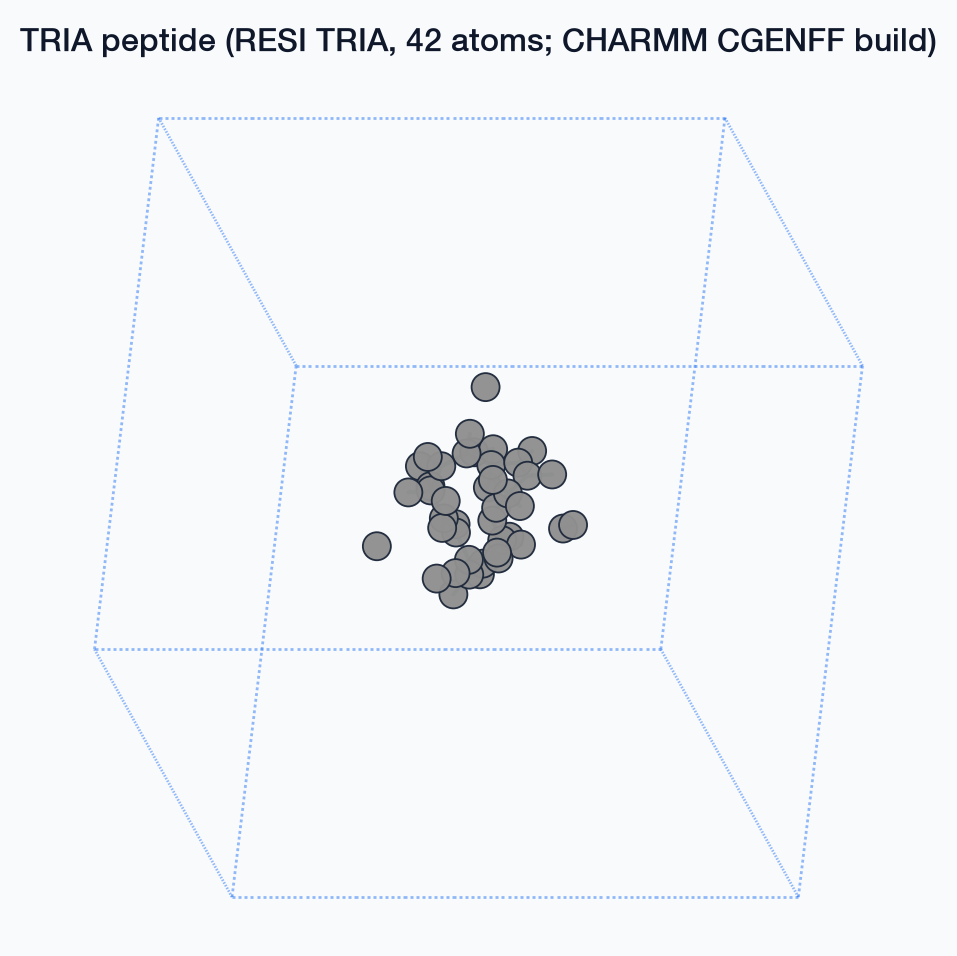
For scale, the underlying CGENFF-built peptide + water box and the isolated
peptide look like this (existing trialanine_water_box builder output):
Diagrams are generated with scripts/generate_docs_figures.py
(uv run python scripts/generate_docs_figures.py), which uses ASE's
plot_atoms/Matplotlib writer under a shared style
(mmml/utils/ase_structure_plot.py) — orthographic projection, covalent
bonds, Jmol or role-based coloring, consistent typography. Regenerate after
any structure/builder change; CI checks staleness with --check.
3. Code examples¶
3.1 Lower a trialanine/water JSON-style configuration¶
This pure mapping is used by examples/cg_jaxmd_unified.py; it is also a
convenient way to inspect the exact term selection before a live build.
from mmml.md.lowering import runconfig_from_cg_config

cfg = {
    "checkpoint": "examples/sppoky-epoch-0010_params.json",
    "n_waters": 4,
    "box_size": 15.0,
    "seed": 11,
    "dt_fs": 1.0,
    "fire_total_steps": 10,
    "peptide_water_ml": True,
    "peptide_water_ml_core_vdw": True,
}
run_config = runconfig_from_cg_config(cfg, phase="fire")
assert run_config.system.builder == "peptide_water"
assert run_config.terms == ("ml_intra", "mm_nonbonded", "ml_pep_water", "vdw_core")
assert run_config.ensemble.ensemble == "min"
Save cfg as JSON, then run
uv run python examples/cg_jaxmd_unified.py --config path/to/config.json.
Live execution also requires a working PyCHARMM installation and checkpoint.
3.2 Assemble and run a pre-built system¶
This minimal example is the tested assemble_and_run contract. Supplying a
pre-built MolecularSystem avoids a live CHARMM build; the SMD term needs only
the two selected atom indices.
import numpy as np
from mmml.md.assemble import assemble_and_run
from mmml.md.config import EnsembleSpec, RunConfig
from mmml.md.system import SystemSpec

from mmml.md.system import MolecularSystem
system = MolecularSystem(
    R=np.array([[0., 0., 0.], [2., 0., 0.]]), Z=np.array([1, 1]),
    box=None, mol_id=np.array([0, 1]),
)
config = RunConfig(
    system=SystemSpec(builder="psf"), terms=("smd",), backend="jaxmd",
    ensemble=EnsembleSpec(ensemble="nve", dt_fs=0.5, n_steps=10),
)
trajectory = assemble_and_run(
    config, system=system,
    term_kwargs={"smd": {"atom_i": 0, "atom_j": 1,
                          "k_ev_per_A2": 0.5, "target": 1.5}},
)
print(trajectory.n_frames)
3.3 Expose a term composition as an ASE calculator¶
import numpy as np
from ase import Atoms
from mmml.md.assemble import build_hybrid_energy
from mmml.md.system import MolecularSystem

system = MolecularSystem(
    R=np.array([[0., 0., 0.], [2., 0., 0.]]), Z=np.array([1, 1]),
    box=None, mol_id=np.array([0, 1]),
)

energy = build_hybrid_energy(
    system, ("smd",),
    term_kwargs={"smd": {"atom_i": 0, "atom_j": 1,
                          "k_ev_per_A2": 0.5, "target": 1.5}},
)
atoms = Atoms(numbers=system.Z, positions=system.R)
atoms.calc = energy.as_ase_calculator()
print(atoms.get_potential_energy())
For rigid-body Monte Carlo, set sampler="rigid" on RunConfig (or
mmml md-system --jaxmd-unified --sampler rigid). Geometry preservation and
neighbor-list behavior are unit-tested; structural RDF validation against
flexible MD is still open.
With --sampler rigid, the default intermolecular FF is CGenFF
(mm_nonbonded from Packmol/CHARMM params, no ML checkpoint). Alternatively
--ff zbl-mbd-multipoles freezes fragment multipoles and per-atom C6/C8/C10
once at build (from --multipole-checkpoint / --mbd-checkpoint or bundled
defaults), then evaluates classical pair electrostatics + QDO dispersion plus
intermolecular ZBL (cuton=0.1 Å, cutoff=0.6 Å) during MC.
3.4 CLI equivalent (no Python required)¶
mmml md-system --backend jaxmd --jaxmd-unified routes through this same
shared pipeline (runconfig_from_md_system_args → assemble_and_run). Its
CLI surface today wires the Packmol composition builder only; --builder
pyxtal, --template-pdb, and --continue-from raise NotImplementedError
rather than silently falling back to the legacy path:
# Hybrid ML/MM flexible MD (requires --checkpoint)
uv run mmml md-system --setup pbc_nve --backend jaxmd --jaxmd-unified \
  --composition "TIP3:4" --box-size 15.0 \
  --checkpoint examples/sppoky-epoch-0010_params.json \
  --dt-fs 1.0 --ps 0.01 --seed 42

# Rigid MC with CGenFF intermolecular (no checkpoint)
uv run mmml md-system --setup pbc_nvt --backend jaxmd --jaxmd-unified \
  --sampler rigid --ff cgenff \
  --composition "TIP3:4" --box-size 15.0 --ps 0.1 --seed 42

# Rigid MC with ZBL + fixed multipoles + fixed C6 dispersion
uv run mmml md-system --setup pbc_nvt --backend jaxmd --jaxmd-unified \
  --sampler rigid --ff zbl-mbd-multipoles \
  --composition "TIP3:4" --box-size 15.0 --ps 0.1 --seed 42
The full mixed ML-core (peptide) + MM-shell system from §3.1 is reachable
today via the assemble_and_run Python API and examples/cg_jaxmd_unified.py
(a thin JSON-config front-end); wiring the peptide-water builder into
md-system's own CLI flags is tracked as open work in the
roadmap checklist.
See md-system YAML configs for the full flag/YAML
reference and run for the general CLI entry point.
4. Where to look for more detail¶
- Design & decisions — the full architecture, every decided/open question, and the complete roadmap checklist (§11) this page summarizes.
- Handoff notes — implementation-level detail for picking the work back up.
- Hybrid ML/MM decomposition — the physics of the term split in more depth.
workflows/unified_backend_sweep/README.mdandworkflows/mixed_calculator_sweep/— the validation sweeps referenced above.